Platform & Technology
Xeno-Free, Plant-Derived Synthetic Biomaterials for Organoid Research,
Translational Medicine, and Regenerative Innovation
HycopGel system
Provide professional solutions and services to customers with diverse needs
Xeno-Free / Animal-Free Rationale

The HycopGel engineered matrix gel system is constructed using plant biosynthetic raw materials to mimic the extracellular matrix microenvironment. Compared to other systems based on animal cell biological extracts (such as mouse EHS tumor cells), the HycopGel engineered matrix gel system has clear components, making it more suitable for precision medicine and regenerative medicine.

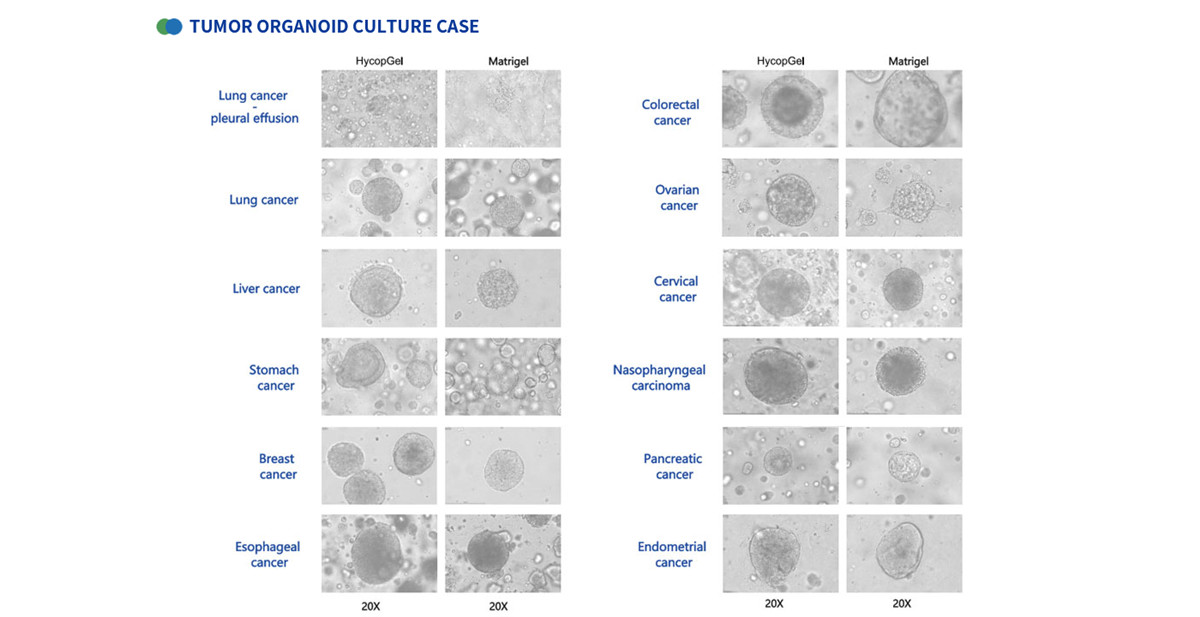
The HycopGel engineered matrix gel system simulates a real growth environment similar to that within tissues by supporting cell adhesion, growth, and migration. Compared to traditional 2D cell culture conditions, using engineered matrix gel to encapsulate cells allows them to grow in a 3D environment that is closer to the natural tissue environment. Currently, the product is applied in the in vitro culture of tumor organoids and organoid-like structures, meeting the needs of precision medicine.

In the future, we will collaborate with the SUPER and BLAST platforms and Phytocall technology to develop products in the fields of drug carriers, wound repair, and tissue regeneration medicine, realizing our vision of green health, safety, and zero pollution.
Material Design

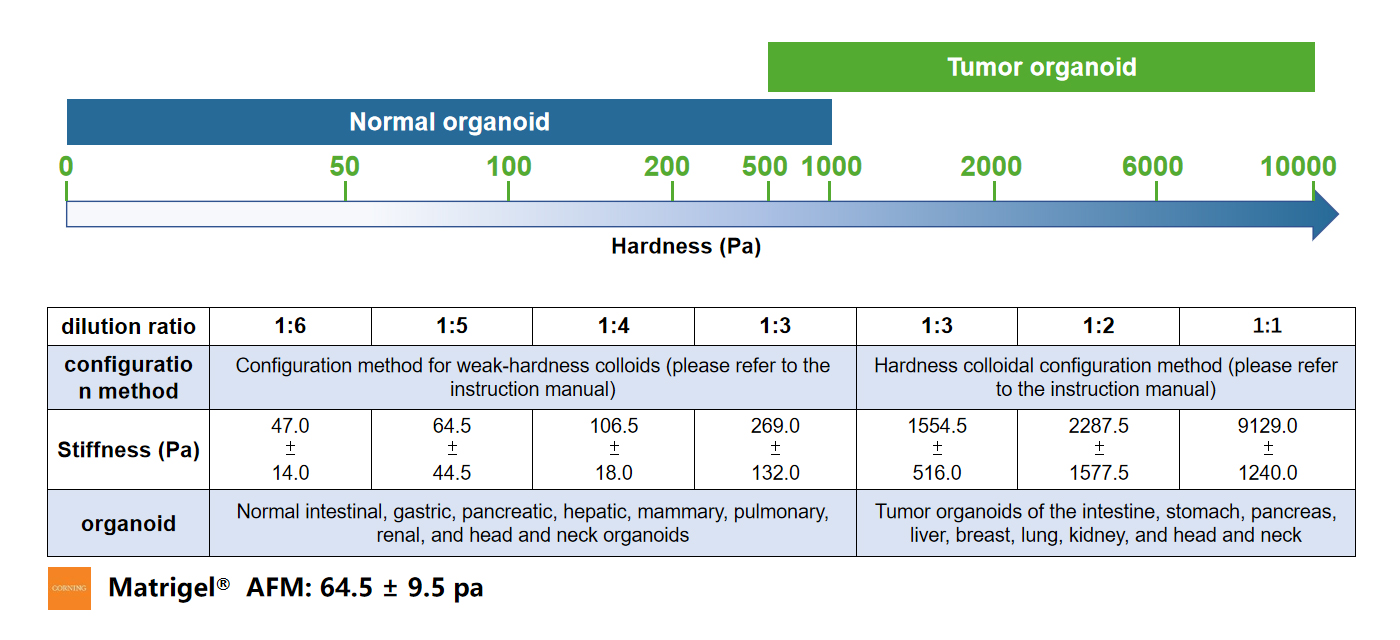
By adjusting the mixing ratio of A Gel, cell suspension, and C Buffer, the hardness of the engineered matrix gel can be adjusted. Hardness regulation is established。The reference table is as follows (the following data were obtained through AFM atomic force microscopy testing).

Workflow Compatibility
ATP
HE Stain
IHC
IF
WB
RNA and qRT-PCR
Scratch test
Medicine sieve
Immune co-culture
Lentiviral infection
Comparison vs Animal-Based ECM
Comparison DimensionEngineered ECMTraditional Matrices (e.g., Matrigel)
Definition / SourceConstructed via artificial design or recombinant proteins; with well-defined composition.Primarily extracted from mouse tumors (e.g., Engelbreth-Holm-Swarm tumor); with complex composition.
Compositional ControllabilityHigh: Precisely controllable components, concentrations, and mechanical properties (stiffness, porosity, etc.).Low: Large batch-to-batch variation, unclear composition (containing contaminants such as growth factors and enzymes).
Standardization LevelHigh: Good batch-to-batch consistency, suitable for standardized experiments and clinical translation.Low: Batch-to-batch variation affects experimental reproducibility.
Mechanical Property TunabilityFlexible: Stiffness and degradation rate can be adjusted by crosslinking density, polymer concentration, etc.Fixed: Dependent on natural composition, with limited room for adjustment.
Biological ActivityFunctional peptides (e.g., RGD sequences) can be designed, but lack the complex signals found in natural matrices.Natural biological activity: Contains various growth factors and matrix proteins to support cellular functions.
ImmunocompatibilityHigh: Humanized or low-immunogenicity materials can be selected.Low: Mouse-derived sources may trigger immune responses, limiting in vivo applications.
Cost & PreparationRelatively high: High R&D and manufacturing costs, with complex preparation processes.Relatively low: Commercially mature and easily accessible.
Application ScenariosTissue engineering, disease modeling, regenerative medicine, high-throughput drug screening.Basic research such as cell culture, organoid culture, and angiogenesis assays.
Experimental ReproducibilityExcellent: Well-defined composition, suitable for mechanistic studies and quantitative analysis.Poor: Batch-to-batch variation leads to fluctuating results.
Clinical Translation PotentialHigh: Meets clinical standards, customizable for specific tissues or diseases.Low: Animal origin and compositional uncertainty pose safety and regulatory barriers.
Storage & StabilityGenerally better stability, flexible storage conditions.Requires storage at -20°C or -80°C; repeated freeze-thaw cycles easily affect performance.
Typical ExamplesSynthetic hydrogels (PEG, alginate, etc.), recombinant collagen/fibronectin.Matrigel®, Cultrex® BME, Geltrex®.

image.png